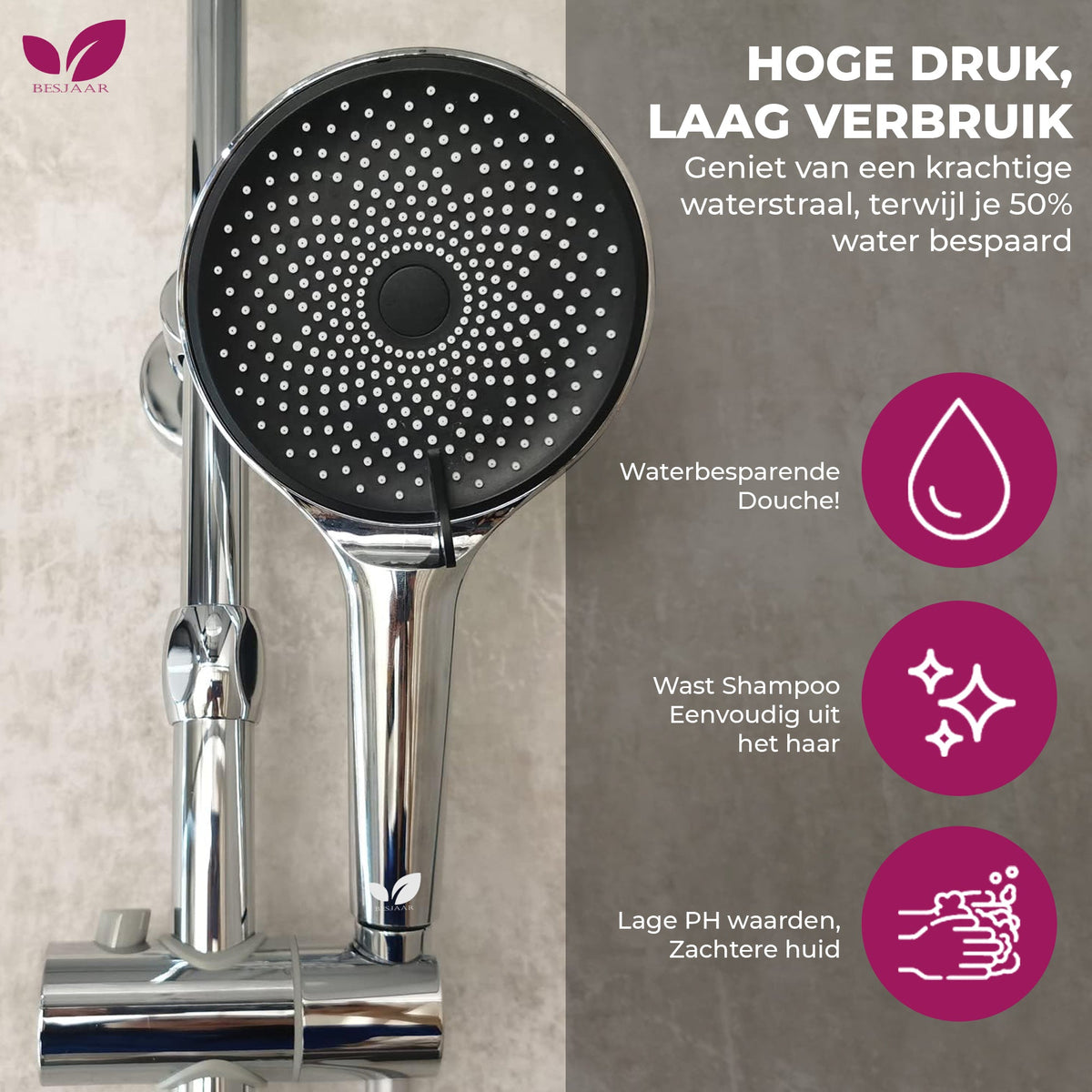
Buying a shower head comes down to seven checks: does the connection fit (almost always G½), how many litres per minute does it use, does it suit your water pressure and your boiler, how many spray modes do you want, do you need a filter, should the hose be replaced too, and is the price right once you include upkeep? This buying guide explains what to look for at each step, with a checklist and honest advice.
Updated: November 2026 · Reading time: about 15 minutes · By the Besjaar team in Assen, the Netherlands
A new shower head costs little and you notice it every day. Still, the choice is huge: hand showers, rain showers, heads with a filter, with or without a hose, from ten euros to several hundred. Packaging uses terms like "high pressure", "water-saving" and "anti-limescale" that often don't mean what you think. This guide helps you through the choice, even if you don't end up choosing Besjaar.
Contents
- Short answer: the 7 checks
- What types of shower heads are there?
- Will a new shower head fit your hose?
- Water use: litres per minute explained
- Check your boiler: the minimum flow rate
- Low or high water pressure
- How many spray modes do you need?
- Shower head with filter: when does it make sense?
- Limescale: choose a head that's easy to keep clean
- With or without a hose?
- Material and finish
- What does a good shower head cost?
- Buying a shower head: online or in a shop?
- Be careful with promises on the packaging
- Shower head buying checklist
- Which Besjaar shower head suits you?
- How to fit your new shower head
- Frequently asked questions about buying a shower head
Short answer: the 7 checks when buying a shower head
- Connection. Almost all hand showers and shower hoses in the Netherlands and the rest of Europe have a universal ½ inch connection (G½). Still, check the product sheet.
- Litres per minute. The fewer litres, the less hot water and gas you use. Milieu Centraal, the independent Dutch information centre on energy and the environment, calls a shower head water-saving at 7.2 litres per minute or less.
- Your boiler. Do you have an old gas water heater or an older non-condensing boiler? Then a very economical head can fall below the minimum flow rate it needs to fire. Modern condensing combi boilers don't have this problem.
- Your water pressure. With low pressure, a compact hand shower that mixes in air works better than a large rain shower.
- Spray modes and features. Two or three good modes are enough for most people. A pause button is handy for saving water.
- Filter or not. Dutch tap water normally contains no chlorine. A filter mainly makes sense in countries where it does, such as Belgium, France and Spain.
- Total price. Include the hose, any replacement filters, shipping, the return period and the warranty.
Below you can read what you need to know for each point.
What types of shower heads are there?
If you're buying a shower head, you first choose a type. That decides whether you can swap it yourself in five minutes or need a plumber.
| Type | What is it? | Suits | Note |
|---|---|---|---|
| Hand shower | A separate shower head on a flexible hose, usually in a holder on a slide rail. | Almost every shower and bath. | Easy to swap yourself without tools. |
| Overhead shower (rain shower) | A large fixed head above you, on a shower arm or the ceiling. | Anyone with a shower system or concealed mixer. | Large heads often use a lot of water and need enough pressure. |
| Rain shower set | A shower column with an overhead shower and a hand shower, on your existing mixer. | Anyone who wants to renew the whole shower. | More installation work, higher water use from the overhead shower. |
| Shower head with filter | A hand shower with a replaceable filter in the handle or head. | Chlorinated tap water, or anyone who wants an extra screen against particles. | Filters need replacing. A filter does not soften water. |
| Shower head with hose | A hand shower including a new shower hose. | An old, stiff or leaking hose. | Slightly more expensive, but you replace everything in one go. |
Torn between a rain shower and a hand shower? Read rain shower or hand shower: which one suits you? The rest of this guide focuses on the hand shower, because that is what most people buy.
Will a new shower head fit your hose? The connection
Good news: in the Netherlands and the rest of Europe, hand showers and shower hoses almost always have the same connection. It's a ½ inch thread, also called G½ or a "universal connection". You screw a new hand shower onto your existing hose by hand.
- Head end of the hose: this usually has a conical end that sits inside the shower head. A rubber washer goes in between.
- Mixer end of the hose: this has a swivel nut that you screw onto the mixer. There's a washer here too.
- Not sure? Milieu Centraal advises taking the old head or hose with you to the shop. If you buy online, look for "G½" or "½ inch" on the product sheet.
You mainly come across a different connection on old or special systems, such as some concealed showers. With a normal shower on a slide rail you're almost always fine. All the terms, from G½ to swivel nut, are in the shower glossary.
Water use: how many litres per minute is good?
This is the most important specification, and it is often printed small on the box. The number of litres per minute decides how much hot water you use. Hot water costs energy: when you shower, the cost is mainly in heating the water, not in the water itself.
The threshold: 7.2 litres per minute
According to Milieu Centraal, a shower head is water-saving if it lets through between 4.0 and at most 7.2 litres of water per minute. By their calculation, a water-saving head saves about 20 percent of water and energy per shower. If it replaces a rain shower, that rises to 40 percent. For an average Dutch household, that comes to about 6,700 litres of hot water and over 40 cubic metres of gas a year, together around 60 euros (Milieu Centraal example, May 2023).
Flow classes on the packaging
Sometimes the packaging shows a letter instead of a number. That is the flow class according to the European standard EN 1112. DIY stores in the Netherlands and Belgium usually use this classification:
| Class | Litres per minute | What does it mean? |
|---|---|---|
| Z | 4.3 – 6.9 | Eco shower, the most economical |
| A | 7.0 – 8.7 | Economical |
| S | 8.8 – 11.5 | Standard |
| B | 11.6 – 14.4 | Generous |
| C | 14.5 – 17.3 | Comfort shower |
| D | 17.4 – 21.9 | Large rain shower |
Note: the class depends on the water pressure at which it was measured, and not every manufacturer measures the same way. That's why litres per minute is the clearest measure. Does it say "ZZ" or "Z"? Then you've got an economical head.
Worked example: what do 4 litres per minute save?
Say your old shower head gives 12 litres per minute and your new one 8. You shower for 8 minutes, five times a week.
- Old head: 8 × 12 = 96 litres per shower.
- New head: 8 × 8 = 64 litres per shower.
- Difference: 32 litres each time, over 8,300 litres per person per year. Almost all of it hot water.
What that means in euros depends on your gas price and boiler. Work it out yourself with the bucket test: what does a shower cost? More background in water-saving shower head: how much do you really save?
Measure your current shower head with the bucket test
Turn the shower on at showering temperature. Hold a bucket under it for exactly one minute. More than 7 litres in it? Then a more economical head will pay off. 12 litres or more, and the gain is big.
Honest about Besjaar: the Besjaar shower heads with 3 modes let through at most 8 litres per minute. That's more economical than most older heads and falls in class A, but it is just above Milieu Centraal's 7.2-litre threshold. Want to save even more? Shower a minute less, or use a head with a pause button.
Check your boiler: the minimum flow rate
Many buyers forget this point. A combi boiler or gas water heater only fires up when enough water flows through. That minimum amount is the minimum flow rate (ignition threshold). If your shower head stays below it, the appliance switches off and you end up under a cold shower.
- Modern condensing boiler: according to Milieu Centraal, works fine with a water-saving shower head.
- Older non-condensing boiler or gas water heater: can have a high minimum flow rate. Don't choose an extremely economical eco shower then, or have the threshold checked.
- Gas or electric hot water tank: has no minimum flow rate. The tank size does decide how long your hot water lasts. Read more in showering with a hot water tank or heat pump.
Notice fluctuating temperatures after changing your head? Try another mode, or a head that lets through slightly more water.
Low or high water pressure: which shower head fits?
A shower head can't increase the pressure in your pipes. What a head can do is distribute the water more cleverly. Smaller nozzles and air mixing (air injection) make the spray fuller and more powerful without extra water. That's usually what manufacturers mean by a "high-pressure shower head". More in high-pressure shower head: what does it actually mean?
- Low water pressure (for example on an upper floor or in an old house): choose a compact hand shower with air mixing. Avoid large rain showers; they need a lot of water to work well. See shower head for low water pressure and low water pressure in the shower.
- High water pressure: almost any head works well. A flow limiter keeps your consumption in check. See shower head for high water pressure.
- Suddenly a poor spray? It's often limescale in the nozzles, not a pressure problem. Descale first before you buy a new one.
How many spray modes do you really need?
More modes sounds luxurious, but most people use two or three. Look above all at what the modes do:
- Rain: a wide, soft spray for everyday use.
- Massage or power: a strong, focused spray. Handy for rinsing shampoo out of thick hair.
- Mist or soft mode: pleasant for sensitive skin or children.
- Jet spray: handy for rinsing the bath, the shower tray or the dog.
- Pause button: stops the water while you lather up, without having to find the right temperature again. Pause for 30 percent of the time and you also save about 30 percent.
Check how you switch: with a button or a dial. A dial is harder to turn with wet, soapy hands than a clear button.
Shower head with filter: when does it make sense?
Shower heads with a filter are popular. They can be useful, but not for the reason many people think.
- What a good shower filter does: stop loose particles and, depending on the filter material, break down free chlorine. Calcium sulphite is a well-known material for this.
- What a shower filter does not do: make your water softer. Dissolved limescale simply flows through every shower filter. If you have limescale problems all over the house, you need a water softener.
- In the Netherlands: water companies normally don't add chlorine to tap water. So a filter adds little against chlorine here. Read is there chlorine in Dutch tap water?
- In Belgium, France, Germany or Spain: chlorine is more common in tap water there, and a filter does make a difference. See the guides for Belgium, France, Germany and Spain.
- Count the filters: a filter lasts a few months. At Besjaar that's 3 to 5 months per filter; a set of 2 costs €9.99. See what does a shower filter cost per year?
Want to know all the details? Read shower filter: worth it or not? and best shower head with filter 2026.
Limescale: choose a head that's easy to keep clean
In many parts of the Netherlands, tap water contains enough lime to leave deposits. Limescale builds up in the nozzles. The spray starts to sputter, gets thinner and can even go sideways. How hard your water is, you can see in water hardness by province.
- Choose silicone nozzles (also called "anti-limescale nozzles"). You rub limescale off them with your finger.
- Choose a head you can open or descale. A head with a smooth spray plate is easier to keep clean.
- Descale regularly. With vinegar or citric acid, see descaling your shower head: vinegar or citric acid? and removing limescale and preventing it.
So an "anti-limescale shower head" doesn't prevent limescale in your water. It just makes it easier to remove the limescale from the head itself.
Buying a shower head with or without a hose?
A separate shower head is cheaper. But if your hose is worn out, a new head won't solve much. Replace the hose too if:
- it leaks at one of the connections or in the coil;
- it is stiff, cracked or discoloured;
- it keeps twisting into knots;
- you want everything reconnected fresh anyway.
For a new hose, look at the length (1.5 metres is the most common; longer is handy for a bath or tall people), an anti-twist feature and a G½ connection at both ends. Everything about hoses is in choosing a shower hose: length, connection and anti-twist. Already leaking? See leaking shower head or hose first.
Material and finish: plastic or metal?
| Material | Pros | Cons |
|---|---|---|
| Plastic (ABS) with chrome plating | Light in the hand, affordable, and easy to build with extra features such as spray modes or a filter. | Feels less heavy and "premium". |
| Metal (brass or stainless steel) | Sturdy and heavy, long lifespan. | More expensive and heavier in the hand. |
Most hand showers, including those from well-known premium brands, are made of chrome-plated plastic. That is not a sign of poor quality. Look instead at the nozzles, the connection and the warranty.
Finish: chrome is the easiest to match and keep clean. Matt black and gold or copper (often with a PVD coating) look great but often show limescale marks sooner. Choose a finish that matches your mixer, slide rail and holder.
What does a good shower head cost?
A good hand shower doesn't have to be expensive. Roughly, you'll see these price ranges:
- Basic hand shower: about €10 to €30. Pay extra attention to the litres per minute and the nozzles.
- Hand shower from a premium brand such as Grohe or Hansgrohe: often €30 to €60.
- Shower head with filter: often €20 to €40, plus replacement filters.
- Overhead showers and complete rain shower sets: from a few tens to several hundred euros, plus any installation.
Look at the total cost. A slightly more expensive head that uses fewer litres per minute often pays for itself quickly. With a filtered head, the filters count. And include shipping, return costs and warranty in your comparison.
Buying a shower head: online or in a shop?
You can buy a shower head at a DIY store, a bathroom shop, on bol.com or directly from the brand. All fine, but there are differences.
| DIY store or bathroom shop | Online | |
|---|---|---|
| Advantage | You can see and feel the head. You can take the old one along to compare. | More choice, buyer reviews, easy to compare specifications. |
| Returns | No legal right of return; depends on the shop. | By law at least 14 days to change your mind within the EU. |
| Watch out | Specifications are sometimes only printed small on the box. | Check who the seller is and where your product comes from. |
Buying online? Check:
- Is the seller listed in a company register (in the Netherlands: the KvK), with an address in the EU?
- How long is the return period and who pays for return shipping?
- How much warranty do you get on top of your legal rights?
- Are the litres per minute and the connection clearly stated?
- Are the reviews from verified buyers, and do you also read the critical ones?
Be careful with promises on the packaging
Shower heads come with a lot of big words. Here's how to read them:
- "Up to 200% more pressure": the pressure in your pipes doesn't change. The spray can feel fuller thanks to smaller holes or air mixing.
- "Limescale filter" or "soft water": no shower head removes dissolved limescale from the water.
- "Up to 50% water-saving": compared to what? Look at the litres per minute, not at a percentage.
- "Mineral stones", "ions" or "vitamin C": ask yourself whether the seller can show what it does in practice. Choose on spray, consumption and convenience instead.
A reliable brand also tells you what a product can't do. That's a good sign.
Checklist: how to buy the right shower head
- Do the bucket test: how many litres per minute does your current head give?
- Check your connection: G½ (½ inch)? Then almost any hand shower fits.
- Check your water heater: condensing boiler, old gas water heater or hot water tank?
- Choose the type: hand shower, rain shower or complete set.
- Choose the consumption: ideally 8 litres per minute or less, 7.2 or less for maximum savings.
- Choose the spray modes you'll really use, and consider a pause button.
- Filter? Only if your water contains chlorine or you want an extra screen.
- Hose too? Yes, if your current hose leaks, is stiff or twists.
- Silicone nozzles against limescale: a must in most Dutch regions.
- Compare the total price: head, hose, filters, shipping, returns and warranty.
Which Besjaar shower head suits you?
Besjaar is a Dutch brand from Assen, specialising in shower heads and shower filters. All Besjaar shower heads have a wide 13 cm head, silicone nozzles, air mixing and a universal G½ connection. You choose with two questions: do you want a filter, and does the hose need replacing too?

| Model | Modes | Filter | Hose | Price* |
|---|---|---|---|---|
| Besjaar Shower Head 3 modes | 3 (rain, massage, power) | No | No | €19.99 |
| Besjaar Shower Head with Hose | 3 | No | 1.5 m, anti-twist | €29.99 |
| Besjaar Shower Head with Filter | 10 (8 wellness + 2 PowerWash) | 8-stage | No | €25.99 |
| Besjaar Shower Head with Filter and Hose | 10 | 8-stage | 1.5 m | €30.99 |
*Prices November 2026. Also available separately: the Besjaar Shower Hose 1.5 m (€9.99) and replacement filters, set of 2 (€9.99).
How to choose
- You live in the Netherlands and mainly want a pleasant, full spray: the Besjaar Shower Head with 3 modes. At most 8 litres per minute, no filters to replace. Is your hose worn out? Then take the version with hose.
- You want lots of modes, a pause button or to filter chlorinated water: the Besjaar Shower Head with Filter. With 2 PowerWash jets for the bath, shower tray and pets. As a complete set it's called the Shower Head with Filter and Hose.
- Your hose leaks but your head is still fine: just the Besjaar Shower Hose.

To be fair: Besjaar heads are made of ABS with a chrome finish, not metal. And if you're looking for a large fixed overhead rain shower, Besjaar doesn't have one. See all models side by side in which Besjaar shower head suits you? Or browse all Besjaar shower heads and the shower heads with filter.
Buying from Besjaar
- Free shipping in the Netherlands on every order. Order before 16:00 on a working day and we ship the same day.
- Belgium, Germany, France and Spain: €2.99, free from €30. See the shipping policy.
- 30-day returns after receipt, well beyond the legal 14 days. See the returns policy.
- 12-month warranty, on top of your legal rights.
- Reviews: on bol.com, Besjaar shower heads average 4.7 out of 5 stars from more than 430 reviews (November 2026). More in is Besjaar reliable?
You can buy Besjaar directly at www.besjaar.eu or on bol.com. The difference is explained in Besjaar in the webshop or on bol.com.
How to fit your new shower head
You can replace a hand shower yourself, without a plumber and usually without tools:
- Unscrew the old head anticlockwise from the hose.
- Check there's a good rubber washer in the connection. Replace it if it's dried out or torn.
- Screw the new head on clockwise, hand-tight. Don't use pliers on a chrome-plated head.
- Turn the shower on and check for leaks. Dripping? Another quarter turn, or two wraps of PTFE tape around the thread.
The full step-by-step guide is in replacing or fitting a shower head in 5 minutes. Renting your home? First read replacing a shower head in a rented home: is it allowed?
Frequently asked questions about buying a shower head
What should I look for when buying a shower head?
The connection (G½), the litres per minute, your water pressure and boiler, the spray modes, silicone nozzles against limescale, whether you need a filter or a new hose, and the total price including returns and warranty.
Does every shower head fit every shower hose?
Almost always. Hand showers and shower hoses in the Netherlands and the rest of Europe nearly all have a universal ½ inch connection (G½). Only old or special concealed systems may differ.
How many litres per minute should a good shower head use?
For a pleasant and economical shower, 7 to 8 litres per minute is a good guideline. Milieu Centraal calls a shower head water-saving at 7.2 litres per minute or less. Older heads and large rain showers often use 12 litres or more.
What does a good shower head cost?
You can buy a good hand shower from about €20. Premium brands often cost €30 to €60. Large rain shower sets cost more. With a filtered head, also count the replacement filters.
Which shower head is the best?
It depends on your situation. Low water pressure: a compact hand shower with air mixing. Maximum savings: a head of 7.2 litres per minute or less, or a head with a pause button. Chlorinated water: a shower head with filter. Wellness with enough pressure and a large water heater: a rain shower.
Do I need a shower head with filter in the Netherlands?
Usually not for chlorine, because Dutch tap water normally contains no chlorine. A filter doesn't soften water either. Choose a filter if you live in a country with chlorinated water, or if you want the extra features of such a head (modes, pause button).
Does a water-saving shower head work with a combi boiler?
With a modern condensing combi boiler, yes. Older boilers, non-condensing boilers and gas water heaters can have a high minimum flow rate, so they switch off when too little water flows through. Don't choose an extremely economical eco shower then.
What is the difference between a hand shower and a rain shower?
A hand shower hangs on a hose and you can hold it. A rain shower is a large fixed head above you. A rain shower feels generous, but usually uses much more water and needs enough pressure.
How long does a shower head last?
With regular descaling, a shower head lasts for years. Replace it if it leaks, is cracked, or if the spray doesn't recover after descaling. See when does your shower head need replacing?
Can I return a shower head if I don't like it?
When you buy online in the EU, you have at least 14 days by law to change your mind. At Besjaar it's 30 days after receipt. In a physical shop you have no legal right of return; it depends on the shop.
Where can I buy a Besjaar shower head?
Directly in the official webshop at www.besjaar.eu, with free shipping in the Netherlands, or on bol.com.
Sources
- Milieu Centraal – Water-saving shower head guide, May 2023 (in Dutch)
- Kiwa – Shower heads and hand showers according to EN 1112 (in Dutch)
- Stimular – Water-saving shower head or flow limiter, minimum flow rate (in Dutch)
- Besjaar – shipping policy and returns policy
Besjaar makes shower heads and filters for Dutch bathrooms, from Assen. Better water, every day.